

Top-Perfume-Ingredients-You-Should-Know blog
Top Perfume Ingredients You Should Know
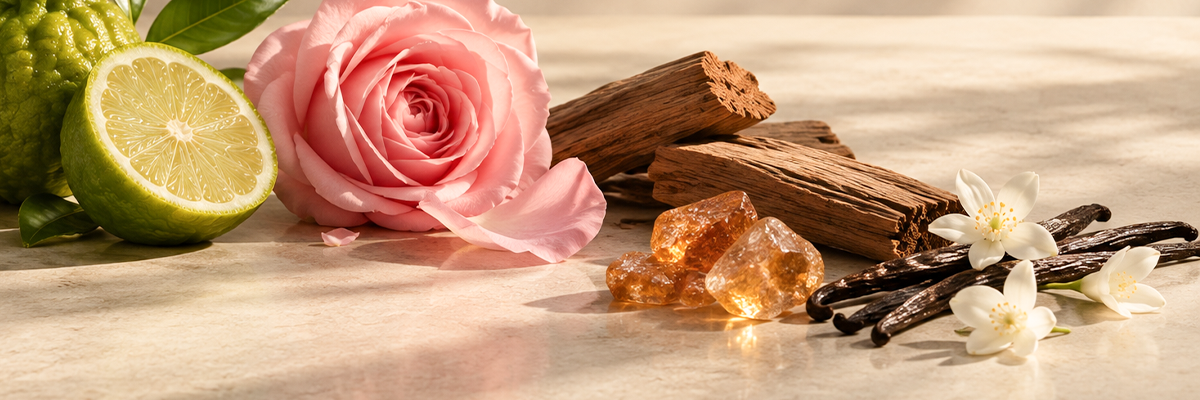
Most people choose a perfume in under sixty seconds. A quick spray, a sniff, and the decision is made. But the ingredients behind that scent are doing something far more deliberate than that.
Every perfume is built from a carefully chosen set of perfume ingredients, each with a distinct character, longevity, and role to play. Bergamot brings a sharp citrus lift to the opening. Sandalwood anchors the dry-down with warmth. Rose absolute adds depth that synthetics rarely replicate. These are not just poetic names on a bottle. They are functional building blocks that determine how a fragrance behaves on your skin, how long it lasts, and how it evolves over hours.
Not all scented products work this way, though. Body mist ingredients are formulated differently. They are lighter and more skin-conditioning, designed to fade rather than linger.
Understanding these perfume ingredients changes how you shop, how you describe what you like, and how you find scents that truly work for you.
What Are Perfume Ingredients?
A perfume is not one thing. It is many things, layered together, timed to appear and fade at different moments. Natural extracts from flowers, woods, resins, and citrus peels. Aroma molecules that recreate scents the way nature does. Essential oils are distilled from roots, bark, and petals. Fixatives that slow everything down so the fragrance can last.
Each ingredient has a role. Some arrive first and leave early. Some carry the heart of the scent through the day. Some anchor everything quietly from underneath, lasting hours after the opening has faded.
The most expensive perfume ingredient in the world is the oud ingredient, which is a resin that forms inside a specific tree only when it is under stress. It takes years to develop and smells like nothing else.
Understanding the Fragrance Notes
Think of a perfume the way you think of a piece of music. There is an opening that is immediate and attention-catching. A middle section where the real theme develops. And an ending that lingers in the room long after the song is over.
Perfume works in exactly the same way. The ingredients are arranged in three stages, each one revealing itself in its own time. Understanding this structure helps you find perfume by ingredients and choose the one that is right for you.
Top Notes - The First Impression
These are the ingredients you smell in the first few minutes. Light, bright, and quick to evaporate, they include citrus notes like lemon, bergamot, and mandarin, as well as green accords that smell like fresh air and cut stems. A hint of spice can appear here too, waking you up before settling into something warmer.
Top notes are what you smell on the paper strip at the counter. They are what make someone stop and say that something is nice, but they are not the whole story. They are the introduction. Floral perfume ingredients often begin here as well. Orange flower, for instance, opens bright and clean before softening into its true warmth over time.
Perfumes like SKINN by Titan Pristine open with citrus and green top notes, giving them an immediate, crisp, easy-to-step-into quality. That first impression is there to invite you in.
Heart Notes - The Soul of the Perfume
Wait twenty minutes after spraying and smell again. What you find now is the heart of the fragrance.
Rose, jasmine, marine accords that feel like standing somewhere near open water, and spices that feel warm and close are all classic heart notes. These mid-notes define the character of a perfume. They are what you are really buying, even if the top notes were what first caught your attention.
The heart is where personality lives. It is where one perfume separates itself from another, and where the woman who wears it becomes inseparable from the scent itself.
Base Notes - Depth and Longevity
Hours later, when everything else has quieted down, the base is still there.
Musk, patchouli, sandalwood, and amber are the heaviest ingredients and the slowest to evaporate. They give a perfume its staying power and its richness. They are also why two people can wear the same perfume and smell completely different, because the base notes interact with your skin chemistry in a way that belongs entirely to you.
In SKINN EDPs, base ingredients like sandalwood and amber are not afterthoughts. They are the architecture that holds everything else up and carries the fragrance through the day.
Most Popular Perfume Ingredients in Luxury Fragrances
Luxury fragrance is built on a handful of ingredients that have been at the centre of perfumery for centuries. Understanding what they are and why they matter will help you make a more considered, more personal choice.
Oud - The King of Ingredients
Oud is a resinous ingredient that forms inside the Aquilaria tree when it becomes infected with a particular mould. The tree responds by producing a dark, dense resin that, when distilled, becomes one of the most complex smells in the world. Woody, smoky, slightly sweet, with a warmth that feels almost alive.
It is one of the most expensive perfume ingredients because it is genuinely rare and the process of obtaining it cannot be rushed. A true oud note lasts all day. It does not fade quietly. It deepens as the hours pass, becoming richer and more personal as it settles into the skin.
Citrus Ingredients - Fresh and Vibrant
Bergamot, lemon, and mandarin are the ingredients that make a fragrance feel like a deep breath on a good morning. They lift the mood and energise the senses, and they are almost universally pleasing, which is why they appear so often in top notes.
They do not linger the way woody notes do, but they set a mood that the rest of the perfume carries forward throughout the day.
Floral Components - Elegant and Feminine
Jasmine and rose are the two great pillars of floral perfumery. Jasmine brings warmth and an almost honeyed richness to the heart of a fragrance. Rose brings softness and a timeless elegance that has never gone out of style.
These are the ingredients most associated with women's perfumes, not because they are delicate, but because they are enduring. They have been beautiful for as long as perfumers have known how to use them. SKINN's floral blends, which include notes of peony, orange flower, and jasmine, use these ingredients with a lightness that never becomes heavy or overwhelming.
Woody Aromas - Warm and Timeless
Sandalwood is creamy and smooth, with a warmth that feels close and safe. Cedarwood is drier and sharper, more architectural in character. Patchouli is earthy and deep, with an intensity that, once you recognise it, you never forget. Woody ingredients are the ones that make a perfume feel settled and assured.
Musk and Amber Accords - Sensual Finish
Musk is not a single ingredient but a family of ingredients, some animalic, some clean, some powdery, that create a softness close to the skin. It is the note that makes a perfume feel like it belongs to you rather than to a bottle.
Amber is warm and resinous, slightly sweet, with a golden quality to it. Together with musk, it forms the base of most modern fragrances, serving as the quiet last word that stays with you through the evening and long into the night.
Why Ingredient Quality Matters
Two perfumes can list the same ingredients on their labels and smell nothing alike. The difference comes down to quality, which encompasses the sourcing, the concentration, and the skill of the perfumer who composed them.
Premium ingredients behave differently on skin. They evolve rather than flatten. They give back to the air rather than simply sitting in it. A fragrance built with quality ingredients does not just last longer. It stays interesting longer, offering something new in the second hour and again in the sixth.
SKINN perfumes are composed with exactly this in mind, bringing together balanced and well-blended notes that were crafted to reward time and attention.
Longevity and Perfume Ingredients
The ingredients that last longest are the ones with the heaviest molecules, including oud, musk, sandalwood, and other woody base notes. They are slow to evaporate because of their density. When a perfume is still perceptible on your skin six hours after you first applied it, it is these base notes doing that work quietly in the background.
If longevity matters to you, and it should, because fragrance is an investment and the whole point is that you carry it with you through your day, then look carefully for these ingredients in the base of any perfume you are considering.
Balanced Notes for Every Day and Every Evening
A citrus-forward fragrance with a light floral heart is made for mornings. Easy, clean, and appropriate for an office or a relaxed weekend without asking for too much attention from the room.
A fragrance built on oud, amber, or dark woody notes is made for the evening. It is slower and richer, the kind of scent that announces itself gently when you walk into a room.
Neither is better than the other. Both have their place. The only question is which one you are reaching for and when.
Shop SKINN Perfumes Crafted with Premium Ingredients
Every SKINN perfume is built around ingredients selected for the experience they create, not just the impression they make in the first moment, but the one that stays with you long after.
The top notes invite you in. The heart stays true as the day unfolds. And the base remains hours later, something personal and quiet, long after the day has ended.
FAQs About Top Perfume Ingredients You Should Know
What are the main perfume ingredients?
Perfumes are built from natural extracts, essential oils, aroma molecules, and fixatives, all arranged in three layers. Top notes include citrus and green accords. Heart notes bring florals, spices, and marine elements. Base notes include musk, oud, sandalwood, and amber. Each layer reveals itself at a different point in time, which is why a perfume smells different an hour after you apply it than it did in the first few minutes.
How do ingredients affect perfume longevity?
Heavy, slow-evaporating ingredients like oud, musk, patchouli, and sandalwood are what give a fragrance its staying power. The richer the base notes, the longer the scent remains on skin. Lighter top notes are beautiful but brief. They are the opening of the story, not the ending.
Which perfume ingredients are best for daily wear?
Fresh, citrus-forward fragrances with floral or light woody hearts wear well every day. They are balanced, easy to be around, and appropriate across most settings. For something that transitions naturally from day to evening, look for a citrus top with a warm amber or musk base. It starts light and deepens as the hours pass, following you through the day without ever feeling like too much.

